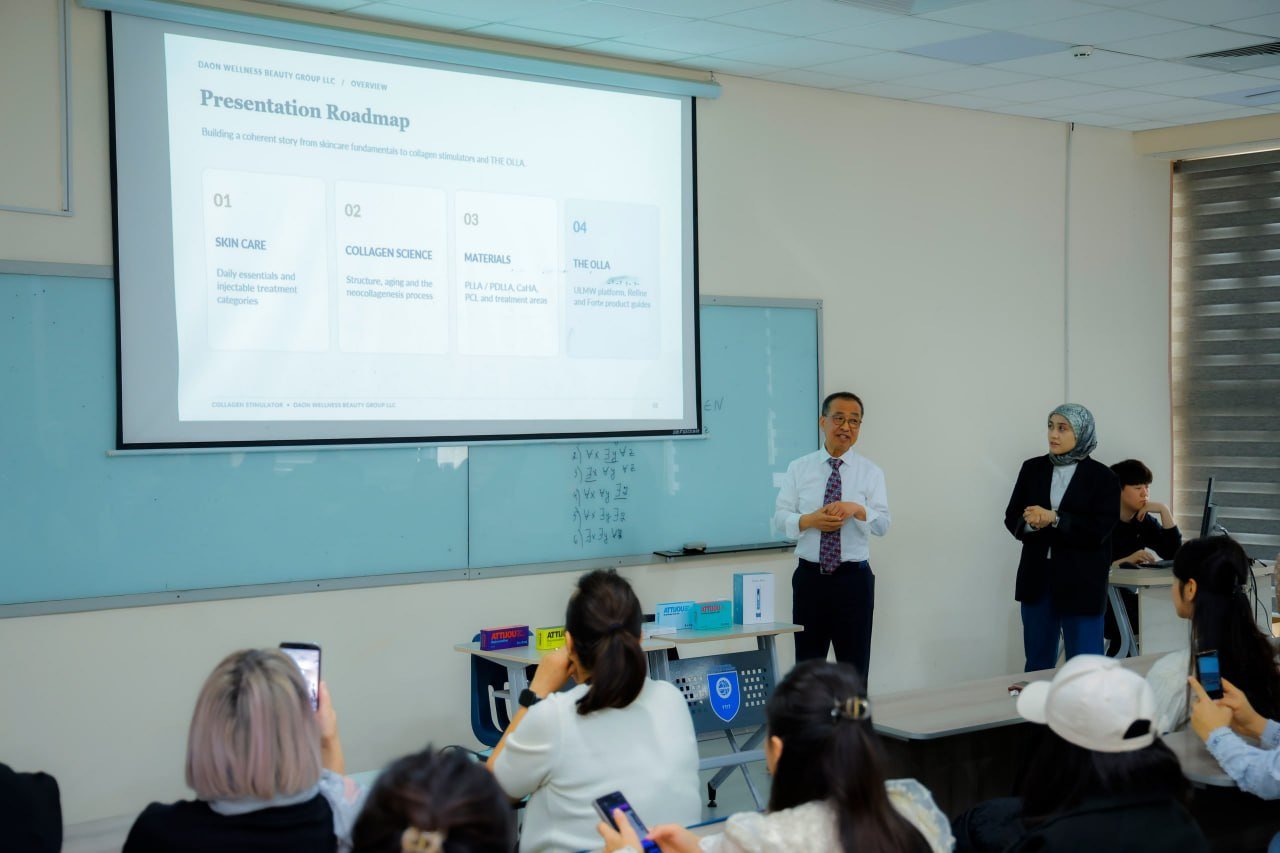
The Science Behind Collagen: KIUT Hosts South Korean Scientist
Today, cosmetology goes far beyond improving physical appearance. Modern aesthetic medicine seeks to understand how the skin regenerates at the cellular level, what accelerates aging, and how the body's natural regenerative abilities can be used. At the heart of these scientific investigations lies a familiar protein: collagen.
Interestingly, collagen accounts for approximately 30% of the total protein in the human body. It plays a crucial role not only in maintaining skin firmness and elasticity but also in supporting the strength of bones, tendons, and other connective tissues. As we age, collagen production and renewal processes in the skin change. This is why modern cosmetology is increasingly focused on stimulating the skin's natural regeneration mechanisms rather than simply improving its appearance.
This topic became the central focus of a scientific and practical seminar held on November 17 at Kimyo International University in Tashkent (KIUT).
At the invitation of the university's Department of Applied Cosmetology, Joong Bae Kim, R&D Director at S OLSION Biomedical and former professor at Tech University of Korea, delivered a lecture on advanced biomaterials and their potential applications in aesthetic medicine.
How Is Modern Science Transforming Skin Rejuvenation?
In recent years, biostimulators have attracted growing attention in aesthetic medicine. While conventional dermal fillers primarily restore volume, certain biostimulatory products are designed to encourage the body's own collagen production.
During the seminar, the expert explained the scientific properties of polymer-based biomaterials, including PLLA, PDLLA, PLGA, and PCL. These materials belong to a family of biodegradable polymers used in medicine, some of which are applied in aesthetic treatments to stimulate collagen formation.
However, the effectiveness of such technologies depends on more than the product itself. Its composition, application technique, individual patient characteristics, and compliance with safety standards are equally important.
Why Is South Korea's Experience Particularly Relevant?
South Korea has gained international recognition for its cosmetics industry, dermatology, and aesthetic medicine technologies. While Korean skincare products have become popular worldwide, the country's scientific research into biomaterials, polymers, and regenerative technologies is equally significant.
Joong Bae Kim's professional experience lies at the intersection of science and industry. His background in research and development offers valuable insights into the journey from studying innovative materials to exploring their practical applications.
The seminar at KIUT also highlighted how modern cosmetology brings together several scientific disciplines, including chemistry, biology, materials science, and medicine.
Why Does This Knowledge Matter for Future Cosmetology Professionals?
As demand for aesthetic procedures continues to grow, the role of a qualified specialist extends far beyond performing treatments. Professionals must understand how the products they use interact with the human body, what results they may produce, and what potential risks they carry.
In this context, the seminar provided KIUT faculty members, researchers, and students with an opportunity to explore contemporary scientific approaches and international expertise.
The future of aesthetic medicine depends not only on innovative products but also on educating professionals who can apply them scientifically, safely, and responsibly. This was the key significance of the international scientific meeting held at KIUT.